
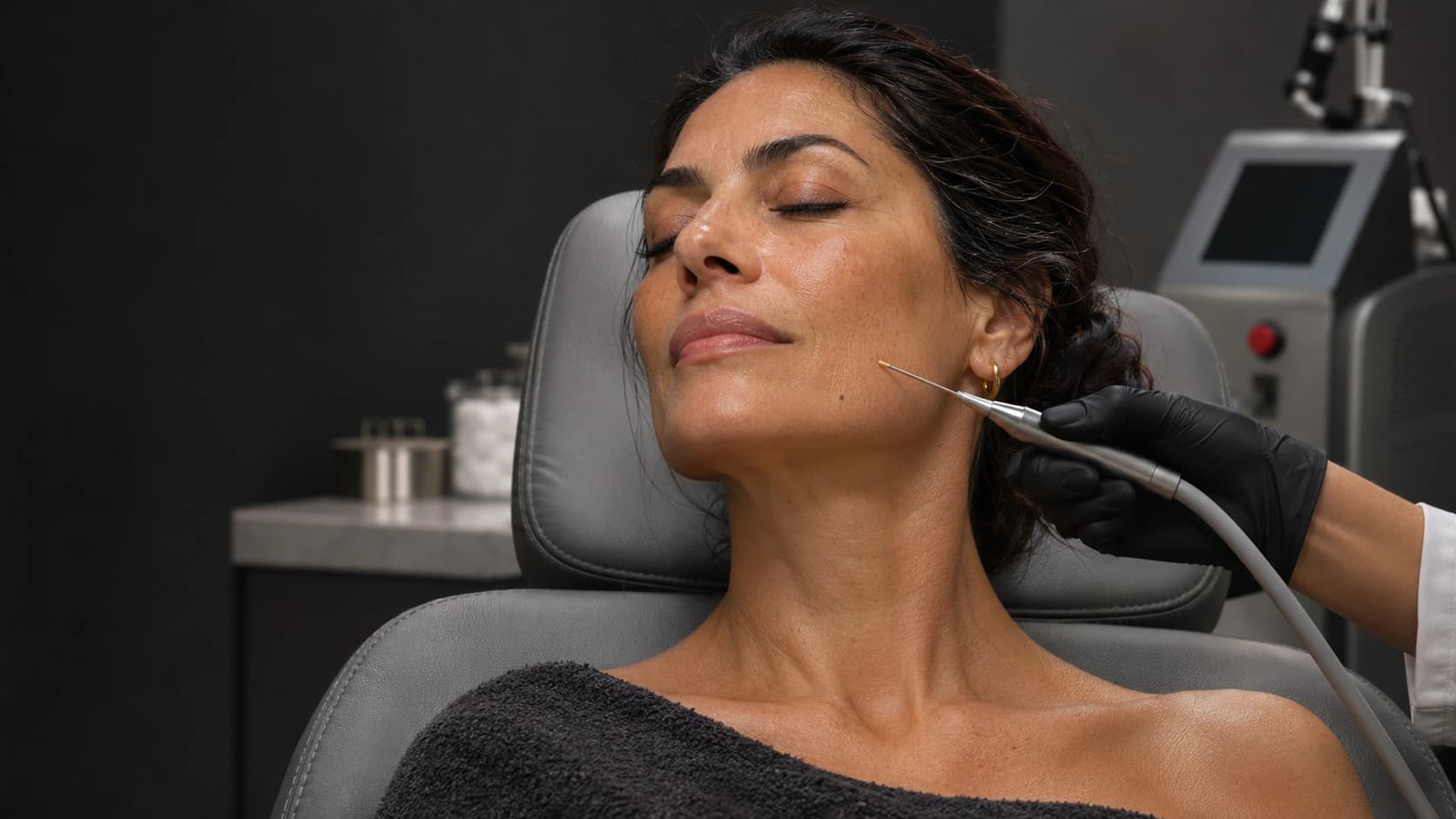
Co2 Laser for Darker Skin Tones and Pigmentation Risk
Learn how previous dark marks, your treatment goal and healing history affect fractional Co2 laser assessment for darker skin tones, including alternatives.
For someone with a darker skin tone considering fractional Co2 laser, a useful first question is “What happens to my skin after a spot, scrape or burn?” A tendency to develop long-lasting dark marks is relevant to the decision. Your usual skin colour, the area being considered and the reason for treatment all belong in the assessment.
A flat mark and an indented scar need different plans
Run a fingertip gently over a healed acne mark. A flat brown patch may be a change in pigment after inflammation. A dent that casts a shadow in side lighting has a change in texture. Both can occur at the same site. Point out which part bothers you most.
Ablative fractional Co2 resurfacing creates small treated columns in the skin. It may improve selected indented scars. The inflammation involved can also leave darker patches as the skin heals. If pigment is already your main concern, ask how the clinician identified its cause and whether resurfacing could make it more visible.
Bring your healing history to the assessment
Tell the practitioner how long marks usually last after breakouts and whether previous procedures caused prolonged redness, lighter patches or raised scars. If you have photographs of a previous reaction, bring them. Discuss active acne, eczema, medicines, recent tanning and your ability to protect the area from sun while it heals.
Ask about the practitioner’s experience treating people with a similar skin response and concern. If a test area is proposed, ask what change they will look for and how long they will observe it. Even a reassuring small test cannot predict precisely how a larger area will heal.
What the research can tell you
In a split-face study of people with acne scars and skin phototypes III and IV, investigators documented post-inflammatory darkening after fractional Co2 treatment. Its findings concern those scar types and participants. Estimates for one group cannot predict the outcome for an individual with a different skin history.
Options such as conventional microneedling or selected non-ablative treatments may be worth discussing for texture. A study of non-ablative fractional resurfacing in phototypes IV to VI also reported temporary hyperpigmentation. Ask about pigment risk and expected benefit for each option, including treating active inflammation first or leaving a healed mark time to fade.
Plan for the weeks after the skin surface heals
Ask when to restart your own skincare and what sun protection is appropriate at each stage. A surface that has healed enough for makeup may still change colour in the following weeks. Arrange a review and ask whom to contact if you develop increasing pain, blisters, spreading redness or an unexpected colour change.
Discuss your options in Mayfair.
Meet the team at 205 Regent Street, London. Talk through suitability, realistic expectations, recovery and your personalised treatment plan.
Explore Co2 resurfacingView current prices & bookSources & further reading
- Clinical study of fractional Co2 resurfacing for atrophic acne scars
- Clinical study of non-ablative resurfacing in skin phototypes IV to VI
First published . Updated .