
How Many PRP Sessions for Hair Loss? Planning & Review
Understand how a hair PRP course is planned, why session numbers and spacing vary, and when to review progress before committing to more treatment.
How many PRP sessions for hair loss are commonly recommended?
For many adults, an initial PRP programme for hair loss involves a course of around three sessions, commonly spaced several weeks apart. However, there is no single number that suits everyone. The right approach depends on the type and pattern of hair loss, how long it has been present, scalp health, medical history and how your hair responds over time.
PRP hair treatment is usually assessed over months rather than days. Some people may notice less shedding or changes in hair quality first, while any visible change in density can take longer because hair follicles follow a slow growth cycle. A clinician should explain the proposed treatment plan, review points and limitations before treatment begins.
What is PRP treatment for thinning hair?
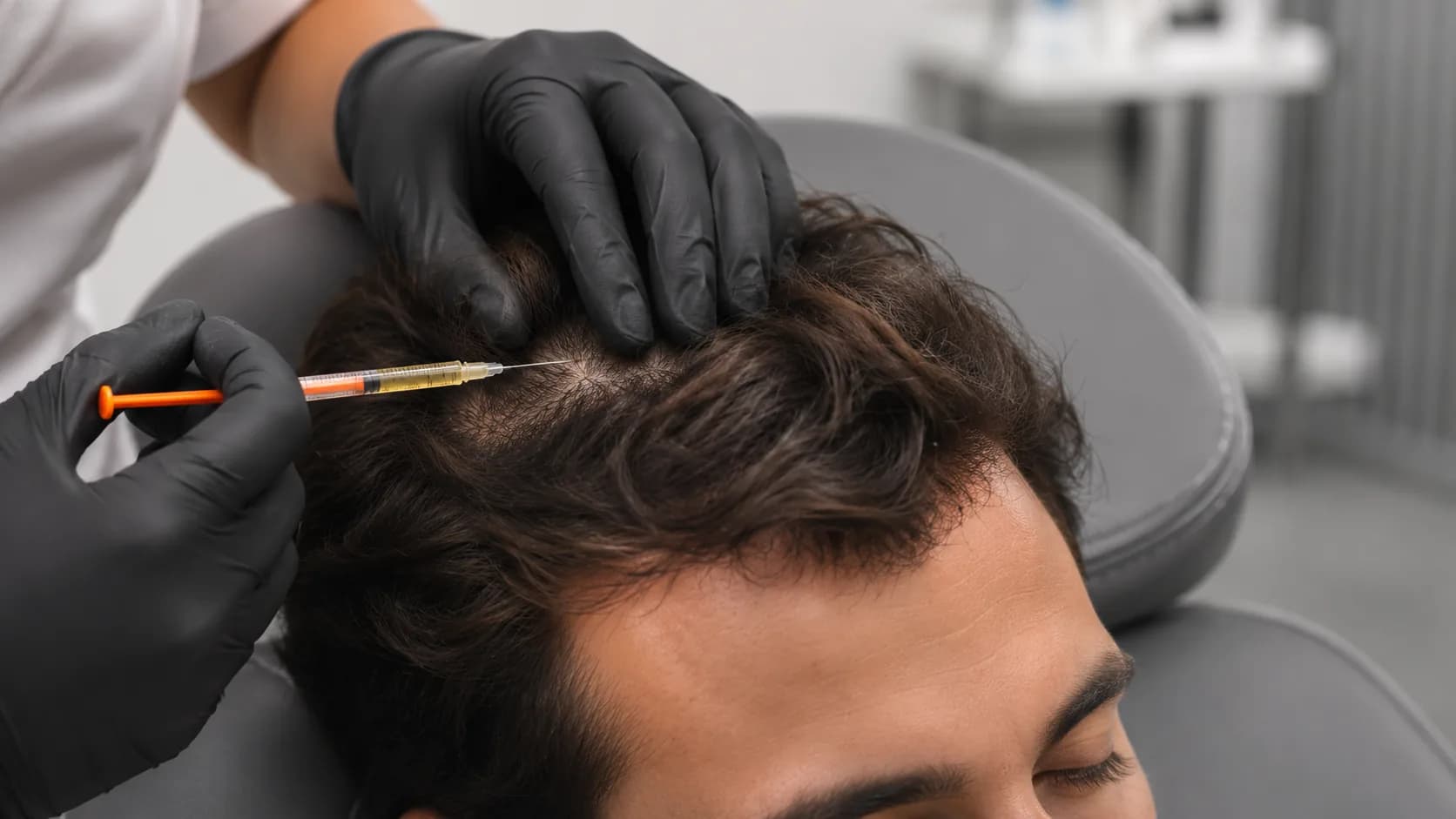
Platelet-rich plasma (PRP) treatment uses a small sample of your own blood. The sample is processed to concentrate platelets within plasma, which is then injected into selected areas of the scalp. Platelets contain signalling proteins involved in normal tissue repair. In hair treatment, PRP is intended to support hair follicles, but response is variable and it cannot restore follicles that are no longer capable of producing hair.
PRP may be considered for some people with early or mild-to-moderate thinning, including pattern hair loss. It is not a replacement for establishing why hair is thinning. Hair loss can have many causes, including hereditary pattern loss, illness, nutritional factors, scalp conditions and certain medicines. The NHS guide to hair loss explains when hair loss may need medical assessment.
Evidence for PRP in hair loss is still developing. It may be helpful for some suitable people, but outcomes are not guaranteed and it is not appropriate for every form of hair loss.
A typical PRP hair loss treatment plan
Although protocols differ, a discussion may include an initial course of three appointments, often arranged about four to six weeks apart. This spacing allows the clinician to monitor your scalp and tolerate treatment appropriately while building a course rather than judging the outcome after one session.
- Initial assessment: review your medical history, hair-loss pattern, scalp condition, medicines and treatment goals. Baseline photographs may be taken with consistent lighting and positioning.
- Initial course: commonly three PRP sessions separated by several weeks.
- First formal review: often planned after the initial course and enough time has passed for hair-cycle changes to be meaningfully assessed.
- Maintenance: if PRP appears helpful, some people choose occasional review or maintenance sessions. The interval should be individualised rather than assumed to be the same for every patient.
The number of sessions may be adjusted if there is a clinical reason to pause, if the diagnosis changes, if side effects occur or if there is no meaningful benefit after an appropriate review period. More sessions do not automatically mean a better outcome.
Price information
A treatment plan should not be based on price alone. It is important to understand what assessment, photography, reviews and aftercare are included, as well as whether PRP is clinically appropriate for your type of hair loss.
What happens at a hair-loss assessment?
A proper assessment is important because “thinning hair” is a description, not a diagnosis. The clinician may ask when the loss began, whether it is gradual or sudden, whether shedding has increased, and whether there have been recent health changes, stressors, illnesses or dietary changes. They may also ask about family history and current medicines.
Your scalp and hair distribution should be examined. Pattern hair loss often has a recognisable distribution, but patchy loss, scalp inflammation, pain, scaling, scarring or rapid shedding may need a different route of investigation.
An assessment should also cover realistic aims. PRP may be discussed as a way of supporting existing, miniaturising hairs in selected cases; it is less likely to be suitable where an area has been bare for a long time or where there is scarring hair loss. If the cause is unclear, further medical assessment may be more appropriate before starting cosmetic treatment.
PRP hair treatment results timeline: when is progress assessed?
PRP is not a quick fix. The visible hair shaft grows slowly, and changes in shedding, hair calibre and coverage may not occur at the same time. For this reason, a PRP hair treatment results timeline should focus on review points rather than promises.
- In the first few days: the scalp may feel tender or mildly swollen, and there may be pinpoint bleeding or bruising at injection sites.
- During the initial course: treatment tolerance, scalp condition and any change in shedding can be discussed. It is usually too early to make firm conclusions about density.
- Several months after starting: standardised photographs and clinical examination can help identify whether there are changes in hair calibre, shedding or visible coverage.
- After the review: the clinician and patient can decide whether maintenance, another approach or no further PRP is reasonable.
Photographs are particularly useful because daily mirror checks can be misleading. Hair length, styling, lighting, wet or dry hair, and camera angle can all make density appear different. Comparison images should be taken as consistently as possible.
Some people do not see a noticeable improvement. If progress is limited, a review should consider whether the diagnosis is correct, whether hair loss is continuing, whether another treatment approach is more suitable, or whether referral is needed.
PRP hair treatment maintenance: is it always needed?
Maintenance is not automatically necessary, and there is no universal schedule. Pattern hair loss is often ongoing, so any supportive treatment may need periodic review rather than being viewed as a one-off solution. If PRP has provided a worthwhile response, maintenance appointments may be discussed based on the individual’s hair-loss pattern, goals, response and budget.
Conversely, if there is no meaningful response after an appropriate initial course and review period, continuing without reassessment may not be sensible. A good PRP hair loss treatment plan includes a clear point at which results are reviewed and options are reconsidered.
Risks, side effects and suitability
Because PRP uses your own blood, the risk of an allergic reaction to the plasma itself is considered low, but treatment is not risk-free. Possible side effects include discomfort during injections, tenderness, redness, swelling, bruising, headache, temporary scalp sensitivity and small amounts of bleeding. Infection is uncommon when appropriate clinical procedures are used, but it remains a possible risk with injections.
People may need to postpone or avoid PRP if they have an active scalp infection, certain bleeding or platelet conditions, significant anaemia, uncontrolled medical conditions or other factors that make treatment unsuitable. Medicines that affect bleeding or platelet function are also relevant. Do not stop prescribed medicine in preparation for PRP unless the clinician responsible for your care advises you to do so.
PRP may not be the right option for sudden, patchy, painful, inflamed or scarring hair loss. These symptoms may require assessment by a GP, dermatologist or other appropriate medical professional. Treatment should only follow an individual assessment by a qualified clinician.
Discuss your options in Mayfair.
Meet the team at 205 Regent Street, London. Talk through suitability, realistic expectations, recovery and your personalised treatment plan.
Explore hair PRPView current prices & bookSources & further reading
- NHS: hair loss and treatment options
- American Academy of Dermatology: hair loss diagnosis and treatment
First published . Updated .