
Hair Transplant Donor Area: Density & Suitability
Learn how donor density, hair calibre, scalp health and future hair loss affect transplant planning, graft numbers and suitability at MHB in London.
What makes a donor area suitable for a hair transplant?
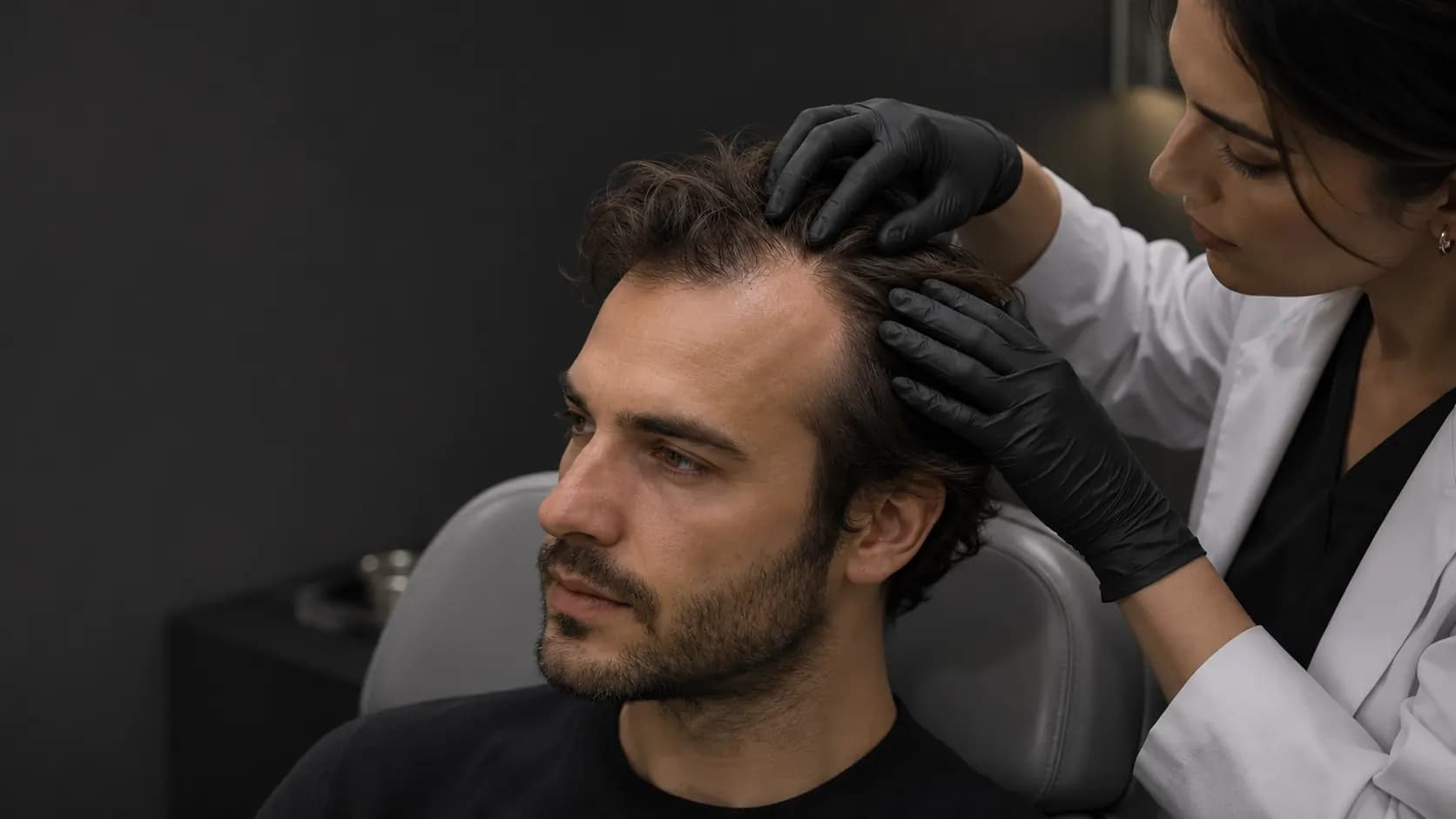
A hair transplant donor area assessment looks at whether there is enough healthy, stable hair at the back and sides of the scalp to be moved safely without making the donor region appear noticeably thinner. It is not simply a question of having thick hair: the distribution, calibre, stability and long-term outlook of the hair all matter.
For most FUE procedures, follicles are taken individually from the back and sides of the head, often called the “safe donor zone”. These hairs may be less affected by common pattern hair loss than hair on the top of the scalp, but they are still a limited resource. A responsible plan protects that supply for the present procedure and any future needs.
Donor suitability can only be judged properly in person. A clinician should assess the scalp, hair-loss pattern, medical history and expectations before recommending surgery. Hair loss can have several causes; the NHS information on hair loss explains why identifying the cause is an important first step.
What is examined during a hair transplant donor area assessment?
The assessment should be as much about planning as it is about counting available follicles. A clinician will usually examine the following factors.
Donor density and distribution
Density refers to how closely follicles are naturally spaced. Good density may provide more flexibility, but an even distribution is equally important. A donor area can look reasonably full overall while containing patches where extraction would be more visible.
During FUE, grafts should be spread thoughtfully rather than repeatedly taken from a small area. This helps preserve a natural-looking donor region and reduces the risk of overharvesting.
Hair calibre, colour and texture
Thicker hair shafts can often create more visual coverage than finer hairs, even where the number of grafts is similar. Wavy or curly hair may also produce a different coverage effect from straight hair. The contrast between hair colour and scalp colour can affect how visible both thinning and donor extraction sites are.
These features influence what can realistically be achieved in areas such as the hairline, temples, mid-scalp or crown. They do not make one person “better” than another; they help guide a proportionate design.
Signs of miniaturisation
Miniaturisation means hairs become progressively finer and shorter. If hairs in the intended donor area are also miniaturising, they may not offer the reliable long-term supply expected from a donor zone. Magnification of the scalp can help identify variation in hair shaft thickness and determine which areas may be less suitable for extraction.
This matters particularly where there is a strong family history of extensive hair loss or where thinning is still progressing. The British Association of Dermatologists provides further information on male-pattern hair loss, including its gradual and variable nature.
The pattern and progression of hair loss
A transplant redistributes existing hair; it does not stop future thinning in untreated areas. If hair loss is currently changing quickly, a surgeon may recommend waiting, monitoring the pattern or discussing non-surgical management first. This can help avoid placing grafts in a way that may look less balanced if surrounding native hair continues to thin.
Scalp health and previous procedures
Active inflammation, infection, significant scarring or a scalp condition should be investigated before surgery. Previous transplants are also relevant because they may have reduced donor density or changed the available extraction pattern. In some cases, a previous procedure does not rule out further surgery, but it makes careful planning more important.
Hair characteristics outside the scalp
In selected cases, beard or body hair may be considered as a supplementary source. However, these hairs can differ in texture, growth behaviour and appearance from scalp hair, so they are not a universal replacement for a limited scalp donor supply. Whether this is appropriate requires an individual surgical assessment.
Hair transplant donor area assessment: how safe extraction is planned
A suitable donor area is not one from which the largest possible number of grafts can be removed. It is one from which an appropriate number can be extracted while retaining an acceptable appearance and preserving options for the future.
With FUE, follicles are removed one by one using a small instrument. The surgeon plans where extraction may take place, avoiding a visibly depleted pattern and respecting areas that may be less stable. The proposed recipient area must then be balanced against the available supply.
- A smaller area of thinning may allow a more concentrated result.
- A large area of thinning may require a staged approach, lower density or a discussion about which area should be prioritised.
- A conservative hairline can preserve grafts and may be more appropriate where future loss is possible.
- Crown work can use a substantial number of grafts because of the natural swirl pattern and surface area involved.
- Existing transplanted grafts and future hair-loss risk should be included in the plan.
No ethical clinician should promise a specific density or guarantee how a transplant will look over time. Healing, graft survival, ongoing native-hair loss and individual biology can all affect the outcome.
What is a weak donor area for a hair transplant?
A weak donor area hair transplant situation usually means the back and sides of the scalp do not have enough stable, well-distributed hair to support the desired coverage safely. This does not always mean surgery is impossible, but it may mean the original goal needs to change.
Common reasons for limited donor supply include:
- Low natural density at the back and sides of the scalp.
- Diffuse thinning affecting the donor region as well as the top of the head.
- Fine hair with high scalp-to-hair colour contrast.
- Prior overharvesting or multiple previous transplant procedures.
- Extensive hair loss requiring more coverage than the donor supply can reasonably provide.
- Scarring, inflammation or an untreated scalp condition.
- Uncertain or rapidly progressive hair-loss patterns.
Overharvesting can leave the donor area looking patchy or see-through, especially with short haircuts. It may also limit the possibility of future surgery. This is why an estimate of graft availability should not be treated as a target to use immediately.
When might a transplant be delayed or not recommended?
Donor area suitability is only one part of transplant suitability. Surgery may be postponed, or an alternative approach may be discussed, where there is active unexplained shedding, scalp disease, a highly unstable hair-loss pattern, unrealistic expectations or insufficient donor supply for the area a person hopes to cover.
A qualified clinician may also recommend investigating possible underlying causes of shedding before considering a procedure. This is particularly relevant where hair loss is sudden, patchy, accompanied by scalp symptoms or unlike a typical gradual pattern.
For some adults, non-surgical options, supportive scalp care or simply monitoring hair loss may be more appropriate than immediate surgery. Available approaches depend on the diagnosis, medical history and personal goals. You can explore the wider range of hair treatments that may be discussed following an assessment.
Risks and limitations to understand
Hair transplantation is a surgical procedure and involves limitations as well as potential benefits. FUE may cause temporary redness, swelling, tenderness, scabbing, itching or altered sensation during healing. Other possible risks include bleeding, infection, visible scarring, uneven donor thinning, shock loss of existing hair and an outcome that does not meet expectations.
Transplanted hair may continue to have the characteristics of the donor hair, but this does not mean future appearance can be guaranteed. Native hair around transplanted grafts may continue to thin, and some people may require ongoing management or consider further treatment later.
Before making a decision, ask how the donor estimate was reached, how the extraction zone will be protected, whether your hair loss appears stable and what result is realistic for your hair type and available supply. A discussion should include the possibility that surgery may not be the most suitable option at this stage.
Questions to ask about donor area suitability
Can a donor area grow back after FUE?
The individual follicles removed during FUE are relocated rather than regenerated in the donor area. Surrounding hairs remain, which is why careful, dispersed extraction is important. Removing too many grafts can make the donor region look thinner.
Can I have a transplant if I wear my hair very short?
Possibly, but short hairstyles can make changes in donor density or small scars more visible. This should be discussed openly during planning, as it may affect the extraction strategy and whether FUE is appropriate for your goals.
Is a thick donor area enough to guarantee a dense result?
No. Recipient-area size, hair calibre, curl pattern, hairline design, scalp contrast, future loss and healing all influence the appearance of coverage. A thick donor area can provide more planning flexibility, but it cannot guarantee a particular outcome.
Discuss your options in Mayfair.
Meet the team at 205 Regent Street, London. Talk through suitability, realistic expectations, recovery and your personalised treatment plan.
Explore hair transplantView current prices & bookSources & further reading
First published . Updated .